

Until now, reading the electric field of light has been a challenge because of the high speeds at which light waves oscillates. The most advanced techniques, which power our phone and internet communications, can currently clock electric fields at up to gigahertz frequencies — covering the radio frequency and microwave regions of the electromagnetic spectrum. Light waves oscillate at much higher rates, allowing a higher density of information to be transmitted. However, the current tools for measuring light fields could resolve only an average signal associated with a ‘pulse’ of light, and not the peaks and valleys within the pulse. Measuring those peaks and valleys within a single pulse is important because it is in that space that information can be packed and delivered.
Artificial intelligence (AI) technology can generate plausible, entertaining, and scientifically interesting titles for potential research articles, finds a study in the Christmas issue of The BMJ. A study of The BMJ’s most popular Christmas research articles — which combine evidence based science with light hearted or quirky themes — finds that AI generated titles were as attractive to readers but that, as in other areas of medicine, performance was enhanced by human input. As such, the researchers say AI could have a role in generating hypotheses or directions for future research.

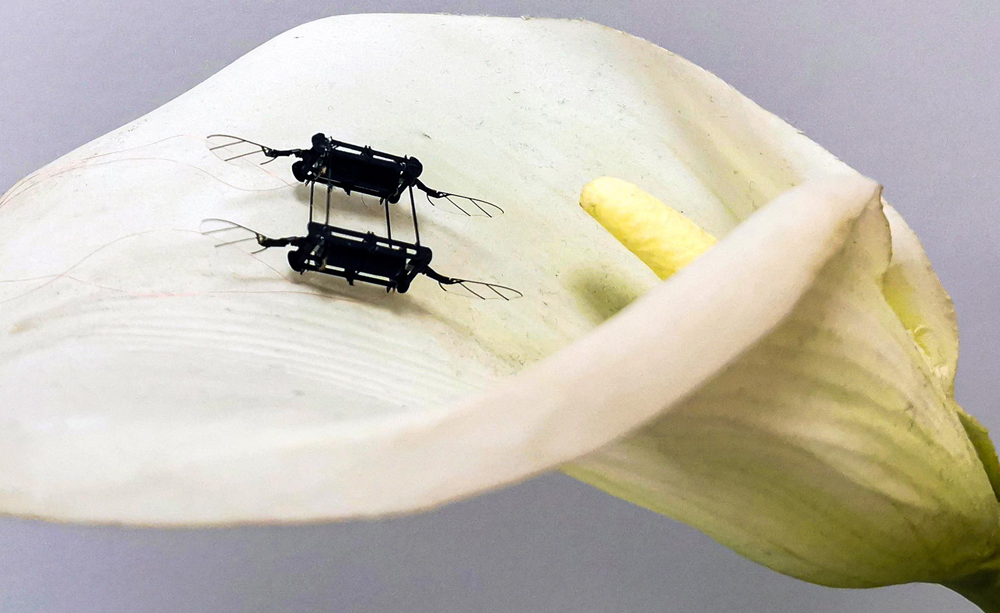
Giving Bug-Like Bots a Boost: New Artificial Muscles Improve the Performance of Flying Microrobots
A new fabrication technique produces low-voltage, power-dense artificial muscles that improve the performance of flying microrobots. When it comes to robots, bigger isn’t always better. Someday, a swarm of insect-sized robots might pollinate a field of crops or search for survivors amid the rubble of a collapsed building. MIT researchers have demonstrated diminutive drones that can zip around with bug-like agility and resilience, which could eventually perform these tasks. The soft actuators that propel these microrobots are very durable, but they require much higher voltages than similarly-sized rigid actuators. The featherweight robots can’t carry the necessary power electronics that would allow them fly on their own.